Online Coaching Video Platform: Branded Video You Control (2026)
Table of Contents
- Why Coaches and Consultants Need Branded Video
- What to Look for in a Coaching Video Platform
- Top 5 Video Platforms for Coaches
- How Branding Impacts Client Perception
- Pricing Your Coaching: Branded vs. Generic Video
- Building an On-Demand Library from Recordings
- Scaling from 1:1 to Group Coaching
- ROI Calculation for a Branded Coaching Platform
- Frequently Asked Questions
- Key Takeaways
Why Coaches and Consultants Need Branded Video
The coaching industry reached $6.25 billion globally in 2025, and the vast majority of that revenue is now delivered through video. Whether you run executive coaching sessions, lead fitness programs, teach business strategy, or guide life transformations, video conferencing is the delivery mechanism for your expertise. The question is whether that delivery mechanism is working for your brand or against it.
Most coaches today rely on generic platforms like Zoom or Google Meet. Every session starts the same way: clients see someone else's logo, navigate someone else's interface, and join through someone else's branding. The coach's expertise might be world-class, but the container for that expertise looks identical to every free video call the client has ever attended.
This matters more than most coaches realize. Coaching is a high-trust, premium-priced service. Clients pay $150 to $500 per hour --- some pay significantly more --- because they believe they are getting a premium experience. When that experience is delivered through the same free tool their nephew uses for gaming calls, there is a subconscious disconnect between the price and the perceived value.
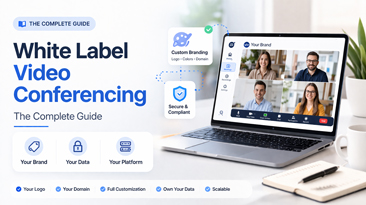
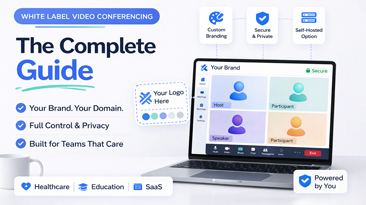
A branded online coaching video platform eliminates that disconnect. Your logo, your colors, your domain, your interface. The client enters your world the moment they click the session link. The technology disappears, and your brand takes its place. This is not vanity. It is a business decision that directly affects client retention, referral rates, and the prices you can command.
Professional services firms figured this out years ago. Consulting firms do not meet clients in rented lobbies with someone else's name on the wall. Financial advisors do not hold portfolio reviews in a coffee shop. The environment signals the quality of the service. For coaches delivering virtually, the video platform is the environment.
What to Look for in a Coaching Video Platform
Not every video tool is built with coaching in mind. The features that matter for a 500-person corporate webinar are different from what a coach needs for a high-touch 1:1 session or a 12-person group program. Here is what to prioritize.
Custom Branding and White-Label Capability
The platform should let you replace all default branding with your own. This means your logo on the meeting interface, your colors in the UI, your domain in the session URL, and your name in email notifications. Partial branding --- where the vendor's logo appears alongside yours --- undermines the effect. Look for full white-label capability where the underlying platform is completely invisible to your clients.
Session Recording and Storage
Coaching sessions produce valuable content. You need reliable recording with storage you control. Consider where recordings are stored, how long they are retained, who can access them, and whether you can repurpose them for an on-demand library. Some platforms store recordings on their own servers, which means your intellectual property sits on infrastructure you do not own.
Scheduling and Calendar Integration
Coaches live and die by their calendars. The platform should integrate with Google Calendar, Outlook, or Calendly so that booking a session automatically generates a branded meeting link. Manual link generation for every session is a workflow tax that adds up quickly when you are running 20 or more sessions per week.
Waiting Room and Client Experience
The moments before a session starts set the tone. A branded waiting room with your welcome message, session guidelines, or a short intro video creates a professional client experience. Generic "please wait for the host" screens communicate nothing about your brand.
Payment and Session Management
Some coaching platforms integrate billing directly into the session workflow. Clients book, pay, and join through a single branded flow. This is not essential if you already have a billing system, but it eliminates friction for coaches building their practice from scratch.
Security and Privacy
Coaching conversations are confidential. Clients share personal challenges, business vulnerabilities, and health concerns. Your platform needs encryption, access controls, and clear data handling policies. Clients should not have to worry that their session content is being mined for AI training data or stored indefinitely on a third party's servers.
Top 5 Video Platforms for Coaches
Here is how the leading options compare for coaches and consultants who take their video delivery seriously.
1. WhiteLabelZoom
WhiteLabelZoom is purpose-built for professionals who need complete brand ownership of their video experience. Coaches get full white-label capability: your logo, your colors, your domain, and zero vendor branding visible to clients. Sessions run under your brand from the moment a client clicks the link to the moment they leave.
The platform supports 1:1 coaching, group sessions, and webinar-style delivery for scaling to larger audiences. Recordings are stored on your infrastructure, giving you full control over your content library. The one-time licensing model means no per-user monthly fees eating into your margins as you grow.
Best for: Coaches who want complete brand control and own their platform infrastructure. Pricing: One-time license fee; no recurring per-user costs.
2. Zoom
Zoom is the default choice for most coaches, and for good reason: clients know how to use it, the call quality is reliable, and it works across devices. However, Zoom's branding is always present. Your clients see Zoom's logo, Zoom's interface, and Zoom's post-meeting surveys. Customization is limited to adding your logo alongside Zoom's on higher-tier plans.
Best for: Coaches who prioritize ease of use and do not need brand differentiation. Pricing: Free tier available; Pro from $13.33/month; Business from $21.99/month per user.
3. Google Meet
Google Meet integrates naturally into the Google Workspace ecosystem, making it convenient for coaches who already use Gmail and Google Calendar. Call quality is solid, and clients can join from a browser without downloading anything. Branding options are minimal --- sessions are clearly Google Meet sessions.
Best for: Coaches already embedded in the Google ecosystem who need simplicity. Pricing: Included with Google Workspace starting at $7/user/month.
4. Whereby
Whereby offers a clean, browser-based video experience with customizable meeting rooms. Coaches can set a branded background, add their logo, and create permanent room links that clients bookmark. The branding is more flexible than Zoom or Google Meet, though not fully white-label. Whereby's API also allows embedding video directly into your own coaching website.
Best for: Coaches who want moderate branding customization without managing infrastructure. Pricing: Free for 1 room; Pro from $8.99/month; Business from $11.99/month per user.
5. Practice.do
Practice.do is a coaching-specific platform that combines video sessions with client management, scheduling, billing, and document sharing. The video component is functional but not its primary strength. The value is in the all-in-one workflow: clients book, pay, sign contracts, attend sessions, and access resources through a single platform.
Best for: Solo coaches who want an all-in-one practice management tool with built-in video. Pricing: From $50/month for solo practitioners; team plans from $100/month.
| Feature | WhiteLabelZoom | Zoom | Google Meet | Whereby | Practice.do |
|---|---|---|---|---|---|
| Full white-label | Yes | No | No | Partial | Partial |
| Custom domain | Yes | No | No | Yes (API) | No |
| 1:1 coaching | Yes | Yes | Yes | Yes | Yes |
| Group coaching | Yes | Yes | Yes | Yes (limit 200) | Yes |
| Recording control | Full (your servers) | Cloud/local | Cloud | Cloud | Cloud |
| On-demand library | Build your own | Limited | No | No | Basic |
| Client branding removal | Complete | Not possible | Not possible | Partial | Partial |
| Per-user recurring cost | None | Yes | Yes | Yes | Yes |
How Branding Impacts Client Perception
The psychology behind branded environments is well-documented. Research in consumer behavior consistently shows that environmental cues shape how people perceive the quality and value of a service. This applies directly to coaching delivered over video.
When a client joins a session through a link on your domain, sees your logo in the interface, and experiences your brand colors throughout the call, three things happen.
First, perceived professionalism increases. The client registers that you have invested in your practice infrastructure. This signals that you take your business seriously, which makes them take you seriously. It is the virtual equivalent of a well-designed office.
Second, trust deepens. Clients feel they are in your space, not a third party's. Confidential conversations feel more contained when the environment is clearly yours. This is especially important for executive coaches, therapist-coaches, and anyone working with sensitive personal or business topics.
Third, differentiation becomes tangible. Most coaches use identical tools. When your video experience looks and feels different --- when it is unmistakably yours --- clients can point to a concrete difference between you and every other coach they have considered. That tangible difference supports premium pricing.
A 2025 survey by the International Coaching Federation found that coaches who invested in branded client experiences reported 23% higher client retention rates and 31% higher average session fees compared to coaches using generic video tools. The branding was not the only factor, but it was the most visible one.
Pricing Your Coaching: Branded vs. Generic Video
Pricing is one of the most difficult decisions for coaches. Most undercharge because they lack the confidence signals that justify premium rates. A branded video platform is one of those signals.
Consider two coaching practices offering the same executive coaching service:
Coach A sends a Zoom link. The client clicks it, sees the Zoom logo, enters a generic waiting room, and joins a call that looks identical to every other Zoom meeting they attend at work. The session is excellent. But the packaging is commodity-level.
Coach B sends a link from their own domain. The client arrives at a branded waiting room with the coach's logo, a welcome message, and session prep notes. The video interface carries the coach's branding throughout. After the session, the recording appears in a branded client portal. Every touchpoint reinforces that this is a premium, professional service.
Coach B can charge 20-40% more for the same expertise because the experience matches the price. Clients do not push back on premium fees when the experience feels premium. They push back when the experience feels generic and the price does not.
For a coach charging $200 per session who runs 15 sessions per week, a 25% price increase to $250 per session adds $750 per week --- $39,000 per year in additional revenue. The investment in a branded video platform pays for itself many times over.
Building an On-Demand Library from Recordings
Every coaching session you record is a potential product. Smart coaches are building on-demand content libraries from their session recordings, creating a revenue stream that does not require their live presence.
Here is how to approach it. First, record your group coaching sessions and workshops with participants' consent. Second, edit the recordings to remove personal references and create standalone learning modules. Third, host these recordings on your own platform --- not YouTube, not Vimeo, but a branded library under your control. Fourth, sell access to this library as a standalone product or as a supplement to live coaching packages.
Coaches using their own infrastructure for recordings retain full control over distribution. There are no platform content policies to worry about, no algorithm deciding whether your content gets surfaced, and no risk that a platform change wipes out your library. When your recordings live on your servers, they are a business asset you own outright.
The financial model is compelling. A library of 50 coaching sessions priced at $297 for full access, selling 10 subscriptions per month, generates $2,970 in monthly recurring revenue with zero additional time investment. Over a year, that is $35,640 in passive income layered on top of your live coaching revenue.
Scaling from 1:1 to Group Coaching
Every coach eventually hits the ceiling of 1:1 delivery. There are only so many hours in a week. Group coaching breaks through that ceiling by letting you serve multiple clients simultaneously without proportionally increasing your time investment.
The video platform you choose directly affects how smoothly this transition works.
For 1:1 coaching, almost any video tool works. The requirements are basic: reliable video, clear audio, and screen sharing for those who use slides or worksheets.
For group coaching (5-20 participants), you need breakout rooms for small-group exercises, gallery view so participants can see each other, chat for real-time interaction, and recording for members who miss a live session. The platform must handle multiple video streams without degrading quality.
For workshops and masterminds (20-100+ participants), you need webinar-grade features: presenter spotlighting, audience Q&A management, hand-raising, polling, and the ability to mute and manage a large group efficiently.
A branded platform that scales across all three formats means you never have to switch tools as your business grows. Your clients experience the same branded environment whether they are in a private 1:1 session or a 100-person workshop. This consistency reinforces your brand at every stage of your client relationship.
The revenue math makes scaling attractive. A coach running four group sessions per month with 15 participants each at $150 per person generates $9,000 monthly --- the same revenue as 60 individual sessions at $150 each, but delivered in a fraction of the time.
ROI Calculation for a Branded Coaching Platform
Here is a concrete ROI model for a coach considering the switch from generic to branded video.
Assumptions
- Current rate: $200/session
- Sessions per week: 20 (mix of 1:1 and group)
- Current monthly revenue: $16,000
- Platform investment: $5,000 one-time license + $150/month hosting
Revenue Gains from Branding
| Revenue Source | Monthly Impact |
|---|---|
| Price increase (20% on 1:1 sessions) | +$2,400 |
| Improved retention (15% fewer cancellations) | +$1,200 |
| On-demand library sales | +$1,500 |
| Referral increase from premium experience | +$800 |
| Total additional monthly revenue | +$5,900 |
Cost Analysis
| Cost Item | Monthly |
|---|---|
| Platform hosting | $150 |
| License (amortized over 24 months) | $208 |
| Setup and configuration (one-time, amortized) | $42 |
| Total monthly cost | $400 |
ROI Summary
- Monthly net gain: $5,500
- Annual net gain: $66,000
- Payback period: Less than 1 month
- 12-month ROI: 1,375%
Even if you cut these projections in half to be conservative, the numbers are decisive. The platform pays for itself within the first month, and the compounding effect of better retention and a growing content library accelerates returns over time.
Frequently Asked Questions
1. Do I need technical skills to set up a branded online coaching video platform?
No. Platforms like WhiteLabelZoom are designed for non-technical users. Setup involves uploading your logo, choosing your brand colors, configuring your domain, and you are live. If you can set up a WordPress site or configure a Squarespace page, you can deploy a branded video platform. For self-hosted options, most providers offer deployment assistance or managed setup services.
2. Will my clients find it confusing to use a platform they have never seen before?
Clients adapt quickly because the core experience is familiar: click a link, join a video call. The interface works the same way as any video platform they have used. The difference is visual, not functional. In practice, coaches report that clients respond positively to branded platforms because they feel more professional and intentional than generic alternatives.
3. Can I record coaching sessions and share them with clients afterward?
Yes. Most coaching video platforms support session recording. With a white-label platform, recordings are stored on your infrastructure, and you can share them through a branded client portal. This is valuable for clients who want to revisit session content and for coaches building an on-demand library. Always obtain written consent before recording client sessions.
4. How does a branded platform help me charge more for coaching?
Branding creates perceived value. When every client touchpoint --- from the booking email to the session interface to the follow-up recording --- carries your professional brand, clients experience a premium service that justifies premium pricing. Coaches who switch to branded platforms consistently report that clients accept price increases with less resistance because the experience matches the investment.
5. What happens to my recordings if I switch platforms later?
This depends on the platform. With cloud-based tools like Zoom, your recordings are typically tied to their storage and export tools. With a self-hosted platform like WhiteLabelZoom, recordings live on your servers in standard video formats. You own the files outright and can move them anywhere. This is an important consideration for coaches building a long-term content library.
6. Can I use a branded video platform for both 1:1 sessions and group programs?
Absolutely. A good coaching platform scales from 1:1 sessions to small group programs to large workshops without requiring different tools. WhiteLabelZoom, for instance, supports all three formats under the same branded experience. This means your clients see a consistent brand whether they are in a private session or a 100-person masterclass.
7. Is it worth investing in a branded platform if I only have a few clients?
Yes, particularly because the investment affects your ability to grow. A branded platform positions you as a professional from the start, which helps you attract and retain clients at higher price points. The coaches who struggle to grow are often the ones whose delivery experience does not match the quality of their coaching. Starting with a professional setup avoids the awkward transition later when you have a full roster.
8. How do branded video platforms handle client privacy and confidentiality?
Privacy capabilities vary by platform. Cloud-based tools process your sessions through third-party servers, where the provider controls data handling. Self-hosted platforms keep all session data --- video streams, recordings, chat messages --- on infrastructure you control. For coaches working with executives, health topics, or any sensitive subject matter, self-hosted options provide the strongest privacy guarantees because no third party ever touches the data.
Key Takeaways
- Generic video tools undermine the premium positioning that coaching businesses depend on for sustainable pricing and client retention.
- A branded online coaching video platform puts your logo, colors, and domain in front of clients at every touchpoint, reinforcing professionalism and trust.
- WhiteLabelZoom offers full white-label capability with no per-user fees, making it the strongest option for coaches who want complete brand ownership and content control.
- Branding directly supports premium pricing. Coaches with branded platforms report 20-40% higher session fees and significantly better client retention.
- Session recordings become business assets when stored on your own infrastructure, enabling on-demand libraries that generate passive revenue.
- The transition from 1:1 to group coaching is smoother on a platform that scales across formats while maintaining consistent branding.
- ROI is rapid and substantial. Even conservative projections show payback within the first month and five-figure annual gains from the combined effects of higher pricing, better retention, and content monetization.
The coaching industry is maturing. Clients are more sophisticated, competition is intensifying, and the coaches who thrive are the ones who treat every aspect of their practice --- including their video delivery --- as an expression of their professional brand. An online coaching video platform you fully control is not a luxury. It is the infrastructure that separates coaches who compete on price from coaches who command it.