White Label Video Conferencing: The Complete Guide
What Is White Label Video Conferencing?
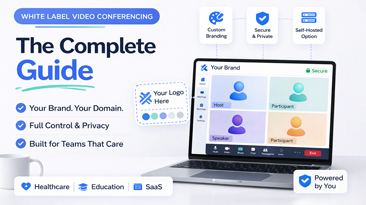
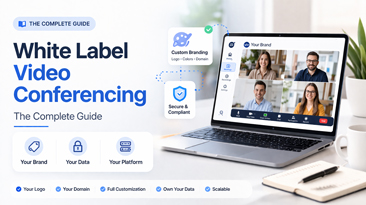
White label video conferencing is exactly what it sounds like: a fully functional video meeting platform that runs under your brand instead of someone else's. Your logo, your colors, your domain, your name in the browser tab. When participants join a call, they see your company — not Zoom, not Google, not Microsoft.
The underlying technology handles everything you'd expect from a modern video tool: HD video and audio, screen sharing, chat, recording, waiting rooms, and more. The difference is ownership. You control the experience, the data, and the branding.
This matters more than most people realize.
Why Businesses Are Moving Away from Branded Tools
Three years ago, nobody questioned putting their team on Zoom. It was the default. But something shifted, and it wasn't just the price increases (though those didn't help).
Brand dilution is real. If you're a consulting firm charging $300/hour, and your client joins a meeting that says "Zoom" everywhere, you've just reminded them that you're using the same $13/month tool as everyone else. If you're a telehealth provider, your patient sees Zoom's logo and thinks "generic video call" instead of "my doctor's secure platform."
Data concerns keep growing. Every time you route a call through a third-party service, your meeting data — participant info, recordings, chat logs, metadata — lives on someone else's servers. For industries like healthcare, legal, and finance, this isn't just uncomfortable. It's a compliance problem.
Vendor lock-in is expensive. Once you've built workflows, integrations, and habits around a specific platform, switching costs are enormous. And the platform knows it. That's why Zoom can raise prices 15-20% year over year and nobody leaves. You're trapped.
Per-user pricing doesn't scale. Growing from 25 to 100 people shouldn't cost you 4x more for the same software. But that's exactly how subscription models work. Your 100th user gets the same product as your first, yet you're paying another $22/month for the privilege.
How White Label Video Conferencing Works (Technically)
Under the hood, most white label video platforms use WebRTC — the same open standard that powers Google Meet and Discord. WebRTC handles peer-to-peer audio and video directly in the browser, without plugins or downloads.
A typical white label setup includes:
- A media server (like Jitsi Videobridge or a custom SFU) that routes video streams between participants
- A signaling server that manages who's in the room, who's muted, screen sharing states, etc.
- A web frontend — the part users actually see and interact with
- A backend API for authentication, room management, recordings, and admin controls
- Infrastructure — your servers, your cloud, your rules
The "white label" part means the frontend and all user-facing elements carry your branding. The backend does the heavy lifting. You get a complete product without building the video engine from scratch.
Who Benefits Most from White Label Video?
SaaS Founders and Platform Builders
If you're building a product that needs video — a coaching platform, an online classroom, a client portal — embedding a white label solution saves you 6-12 months of development time. You get a production-ready video layer that looks like it's part of your product. Your users never know it's not built in-house.
We've seen SaaS founders take WhiteLabelZoom and turn it into a revenue stream — charging their own clients $50-200/month for access to "their" video platform. The one-time license pays for itself in weeks.
Healthcare Organizations
Telehealth isn't optional anymore. Patients expect video visits, and providers need a platform that's HIPAA-compliant, self-hosted, and professional-looking. Having your clinic's name and logo on the video interface builds patient trust in ways that "Join Zoom Meeting" never will.
Read more about the specific requirements in our HIPAA-compliant video conferencing guide.
Education Companies
Online tutoring, cohort-based courses, corporate training — all of these need video, and all of them benefit from branding. Students take a course more seriously when it runs on "AcademyPro's classroom" versus "a Zoom link." EdTech companies using white label video report higher completion rates and better reviews.
Enterprise and Internal Teams
Large companies with 500+ employees often want their internal communication tools branded to the company. It reinforces culture, simplifies IT management (one less vendor to audit), and keeps sensitive meeting data on company-controlled infrastructure.
Consulting and Professional Services
Law firms, accounting firms, executive coaching practices — these businesses sell trust and expertise. The meeting experience is part of the service. A branded platform signals professionalism and justifies premium pricing.
Build vs Buy vs White Label: The Real Trade-offs
You have three options when you need branded video. Here's an honest breakdown.
Option 1: Build from Scratch
Cost: $150,000 - $500,000+ Timeline: 6-18 months Ongoing: 2-4 full-time engineers for maintenance
You'd use WebRTC, probably build on top of open-source components like mediasoup or Pion, write your own signaling server, build the frontend, handle oAuth, recording pipelines, TURN servers, scaling... it's a massive engineering project.
When this makes sense: You're a funded startup where video IS the product (like a Zoom competitor), and you need deep, custom functionality that no off-the-shelf solution provides.
When it doesn't: You just need video as a feature in your product. Building a video engine is like building your own database — technically possible, almost never the right use of resources.
Option 2: Use a Video API (Twilio, Vonage, Daily.co)
Cost: $0.004 - $0.01 per participant-minute Timeline: 2-4 months to build a usable product Ongoing: Usage-based billing that scales with volume
Video APIs give you building blocks — you still need to build the UI, the room management, the recording system, the admin panel. You're buying the engine but assembling the car yourself.
When this makes sense: You need highly custom video UX (like a telemedicine app with specific clinical workflows) and have engineering resources to build and maintain the frontend.
When it doesn't: You want a complete, ready-to-use product. APIs are components, not products. And per-minute billing gets expensive fast — a 100-person meeting running for an hour can cost $24-60 per session.
Option 3: White Label Platform
Cost: $4,997 - $9,997 one-time (for a product like WhiteLabelZoom) Timeline: 48 hours to 2 weeks Ongoing: Hosting costs ($20-300/month depending on scale)
You get a finished, production-ready platform. Branding, deployment, and configuration are either done for you or straightforward with documentation. Updates are included.
When this makes sense: You want branded video conferencing that works out of the box, you don't want to maintain video infrastructure, and you'd rather invest your engineering time in your core product.
When it doesn't: You need a fundamentally different video experience that can't be achieved through configuration and theming. (This is rarer than most people think.)
What to Look for in a White Label Video Provider
Not all white label solutions are equal. Here's what separates the good from the "you'll regret this in six months":
1. Full Source Code Access
If you don't have the source code, you don't actually own the product. You're just renting someone else's software with your logo on it. Full source code means you can customize anything, hire your own developers to extend it, and never worry about the vendor disappearing.
2. Self-Hosting Option
Cloud-hosted white label solutions still route your data through someone else's servers. For true ownership and compliance, you need the option to run everything on your own infrastructure. This is non-negotiable for healthcare, legal, and finance.
3. No Per-User or Per-Minute Fees
The whole point of leaving Zoom is escaping per-user pricing. If your "white label" solution charges per participant or per minute, you've just traded one subscription for another. Look for one-time or flat-fee pricing.
4. Modern Tech Stack
Check what it's built on. Open standards like WebRTC are good. Proprietary protocols are a red flag — they create the same vendor lock-in you're trying to escape. A stack built on Django/React/PostgreSQL or similar mainstream technologies means you can find developers to work on it.
5. Included Features, Not Add-ons
Recording shouldn't be an add-on. Transcription shouldn't be an add-on. Screen sharing shouldn't be an add-on. The nickel-and-diming approach is what made Zoom so expensive in the first place. Your white label platform should include everything.
6. Real Support and Documentation
A pile of source code without documentation is useless. Look for deployment guides, API documentation, configuration references, and actual human support when you get stuck.
The Bottom Line
White label video conferencing isn't a luxury — it's becoming a standard expectation for businesses that take their brand seriously. The technology is mature, the costs have come way down, and the gap between "Zoom link" and "your own platform" is smaller than ever.
Whether you're a SaaS founder adding video to your product, a healthcare provider modernizing telehealth, or an enterprise tired of paying per-seat forever, white label is worth a hard look.
We built WhiteLabelZoom specifically for this use case — a one-time purchase, full source code, deployed in 48 hours. But regardless of which provider you choose, the move away from rented, branded-by-someone-else video tools is one that pays for itself quickly.
Do the math. Check out our Zoom 5-year cost analysis if you want to see the numbers. They speak for themselves.