Video Conferencing for Online Education: Why EdTech Needs Its Own Platform
Zoom Wasn't Built for Your Classroom
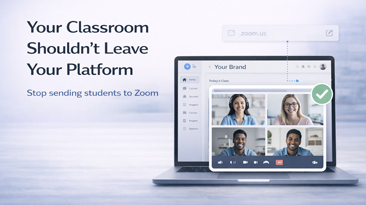
Every EdTech founder hits the same wall. You build a beautiful learning platform — course management, student dashboards, progress tracking, certificates — and then you drop a Zoom link into it. Suddenly your premium education experience redirects students to zoom.us, asks them to download an app, shows them Zoom branding, and occasionally hits them with "Your host hasn't arrived yet" on a loading screen you can't control.
We've talked to dozens of EdTech companies about this. The pattern is always the same: they start with Zoom because it's fast, realize it's a branding nightmare, look at Twilio and get sticker shock, then end up stuck.
Here's what's actually going on.
What Education Platforms Need (That Zoom Doesn't Offer)
Seamless LMS Integration
Students should go from "click Join Class" to being in a video session without leaving your platform. No redirects, no popups, no app downloads. The video experience should feel like a native part of your product.
Zoom's SDK technically allows embedding, but it's limited. You still see Zoom UI elements, the SDK license costs extra, and you're bound by their usage terms. Google Meet doesn't even offer embedding for third parties.
Branded Experience Throughout
When a student joins a live class on your platform, they should see your logo, your colors, and your interface. Not Zoom's. This isn't vanity — it's trust. Parents paying $200/month for tutoring expect a professional, cohesive experience. A Zoom link feels like a workaround, because it is.
Recording Ownership
Education platforms need recordings. Students miss classes, want to review material, or access recorded lectures on demand. With Zoom, recordings live on Zoom's cloud (extra fees) or get downloaded locally (useless for a web platform). You don't control the storage, the delivery, or the access permissions.
What you actually need: recordings saved to your own S3 bucket or cloud storage, accessible through your platform's existing access controls, streamable on demand. This is the difference between "we have recordings" and "we have a content library."
Attendance and Analytics
Which students joined? When did they leave? Who had their camera on? How long did the session last? This data is essential for education platforms — for both instructors and administrators.
Zoom provides some of this through their API, but it's delayed, paginated, and doesn't integrate naturally into your analytics pipeline. You end up building a separate data ingestion system just to answer "did this student attend class?"
Breakout Rooms That Make Sense for Education
Zoom's breakout rooms work for corporate meetings. For education, you need persistent study groups, instructor-controlled room assignments based on student data, and the ability to drop in and out of groups without disrupting the session. Most video platforms treat breakout rooms as a meeting feature, not a pedagogical tool.
The Business Case for Branded Video in EdTech
Let's talk numbers, because this is where it gets interesting.
A mid-sized online tutoring platform with 50 instructors and 500 active students might pay:
| Cost Item | Monthly | Annual |
|---|---|---|
| Zoom Business (50 hosts) | $1,100 | $13,200 |
| Cloud recording add-on | $200 | $2,400 |
| Zoom SDK license (embedding) | $500 | $6,000 |
| Total Zoom cost | $1,800 | $21,600 |
Over three years, that's $64,800 — for a product that still shows Zoom branding and limits your integration options.
Meanwhile, the platform charges students $150-300/month. The video experience is a core part of the product, yet it's the one part they don't control.
Here's the alternative math: a one-time investment of $4,997-$9,997 for a white-label video platform you own entirely. Hosting costs of $50-150/month depending on scale. Total three-year cost: under $10,000. And you own it.
Self-Hosted vs. Cloud for Schools
This is a genuine decision, not a no-brainer. Let me be honest about both sides.
Cloud-Hosted (Managed)
Best for: EdTech startups under 200 concurrent students, teams without DevOps experience, platforms that need to launch fast.
You deploy on a managed cloud provider (AWS, DigitalOcean, etc.) and the video infrastructure runs on standard cloud compute. You're responsible for the server, but it's straightforward.
Pros: Simple setup, predictable costs, easy scaling Cons: Data is on cloud provider's infrastructure (fine for most, not ideal for K-12 with strict data residency requirements)
Self-Hosted (On-Premise)
Best for: K-12 districts with FERPA/COPPA concerns, international schools with data residency requirements, universities with existing infrastructure.
The platform runs on servers you physically control or on a private cloud with strict data isolation.
Pros: Maximum data control, compliance with strict regulations, no external dependencies Cons: Requires IT staff, more complex setup, hardware costs
For most EdTech companies, cloud-hosted is the right answer. You get full control of the software and branding while keeping infrastructure simple. Self-hosted matters when regulations demand it — and if you're in K-12, they sometimes do.
Why One-Time Pricing Matters for Thin-Margin EdTech
EdTech is not a high-margin business for most companies. After content creation costs, instructor payments, platform development, and customer acquisition, margins are often 15-30%. Every monthly SaaS subscription eats directly into that.
Per-user video pricing is particularly brutal for education. A coaching platform with 1,000 students paying $50/month generates $50,000 in monthly revenue. If video costs $5/student/month (common with API-based solutions), that's $5,000 — 10% of revenue going to video alone. Scale to 5,000 students and you're paying $25,000/month for video.
One-time pricing fundamentally changes this equation. WhiteLabelZoom costs $4,997-$9,997 once. Hosting runs $50-300/month depending on scale. As your student count grows, your video costs stay essentially flat. At 5,000 students, you're paying maybe $200/month for hosting instead of $25,000/month for API-based video. That's the difference between a sustainable business and a business that can't afford to grow.
What a Proper EdTech Video Setup Looks Like
Here's the architecture we recommend for education platforms:
- Embedded video player — iframe or web component that loads inside your LMS, styled to match your brand
- Session management API — your backend creates rooms, generates join tokens, controls permissions
- Recording pipeline — sessions auto-record to your S3 bucket, accessible through your content delivery system
- Webhook events — participant joined, participant left, recording ready — all pushed to your backend for attendance tracking
- Instructor controls — mute all, spotlight speaker, manage breakout rooms, share screen — all through your branded UI
This is what a native video experience looks like. Students never leave your platform. Instructors use your tools. Data flows into your systems. And the whole thing looks like you built it yourself.
When to Use Zoom (Seriously)
If you're a solo instructor teaching 10 students on Teachable, use Zoom. It's $13.33/month, it works, and building custom video infrastructure would be absurd for your situation.
If you're an EdTech company with 100+ students, a branded platform, and ambitions to scale — that's when the economics flip. Zoom becomes a branding liability and a cost center. The moment video is a core part of your product (not just a nice-to-have), you need to own it.
Making the Switch
The transition doesn't have to be dramatic. Most EdTech companies we work with at WhiteLabelZoom follow this path:
- Deploy the white-label platform alongside Zoom (1-2 days)
- Migrate one instructor cohort as a pilot (1 week)
- Gather feedback, adjust branding and settings (1 week)
- Roll out to all instructors and students (1-2 weeks)
Total transition: about a month, with zero downtime and minimal disruption.
The result: a video experience that feels native to your platform, costs a fraction of what you were paying, and scales with your business instead of against it.
Bottom Line
EdTech platforms that treat video as a commodity — just drop in a Zoom link — are leaving money, brand equity, and user experience on the table. The platforms that own their video experience are the ones students (and parents) trust, recommend, and stay with.
The technology exists to own this. The price point has come down to where it makes sense for any EdTech company past the startup stage. The question isn't whether you can afford your own video platform. It's whether you can afford to keep renting someone else's.