WhiteLabelZoom vs Whereby: Embedded Video Conferencing Compared (2026)
Table of Contents
- Introduction
- Platform Overviews
- The Core Distinction: Widget vs Platform
- Feature-by-Feature Comparison Table
- Pricing Deep Dive: Per-Minute Fees vs One-Time Purchase
- 3-Year Total Cost Analysis
- Branding Depth: Skinning a Widget vs Owning the Experience
- Self-Hosting and Data Control
- Who Should Use Whereby
- Who Should Use WhiteLabelZoom
- Frequently Asked Questions
- Final Verdict
Introduction
If you are searching for a whereby alternative, you have probably already tried embedding Whereby's video widget into your product or website. It works. A few lines of code, a meeting room loads in an iframe, and your users can talk face to face. Simple. Fast. Done.
Then the invoice arrives. Per-minute billing. Overage charges. A growing line item that scales with every new customer you onboard.
Whereby and WhiteLabelZoom both solve the same fundamental problem: putting embedded video conferencing into your application. But they approach it from opposite ends of the spectrum. Whereby gives you a video widget you rent by the minute. WhiteLabelZoom gives you a complete video platform you buy once and own forever.
This article breaks down both platforms across pricing, branding depth, self-hosting, and platform ownership so you can make the right choice.
Platform Overviews
Whereby
Whereby (formerly appear.in) is a Norwegian video conferencing company that offers an embeddable video API and SDK called Whereby Embedded. Developers drop a video room into any web application using an iframe embed or browser SDK.
Whereby handles all media infrastructure through their managed cloud. You interact with the platform through their REST API to create rooms, manage participants, and retrieve recordings. The meeting UI is Whereby's pre-built interface, customizable within the boundaries they provide.
Pricing is usage-based, calculated on participant minutes. Every minute a participant spends in a Whereby-powered meeting is metered and billed.
Key characteristics:
- Embeddable video widget via iframe or JavaScript SDK
- Cloud-hosted only (managed by Whereby)
- Per-minute usage-based pricing
- Pre-built meeting UI with limited customization
- REST API for room management
- No source code access
- No self-hosting option
WhiteLabelZoom
WhiteLabelZoom is a self-hosted, white-label video conferencing platform purchased as a one-time license. Built on open-source WebRTC and SFU technology, it provides HD video meetings, webinars, screen sharing, breakout rooms, recording, and a full admin dashboard --- all deployable on your own servers.
You buy the software once. Higher-tier plans include full source code access. There are no recurring platform fees, no per-minute charges, and no usage caps.
Key characteristics:
- Complete video conferencing platform (not just a widget)
- Self-hosted on any VPS, AWS, DigitalOcean, or private infrastructure
- Built on open-source WebRTC/SFU technology
- One-time purchase starting at $4,997
- Full source code access on higher tiers
- Zero recurring platform fees or per-minute billing
- Up to 500 participants per meeting (scalable)
The Core Distinction: Widget vs Platform
This is the most important section of this comparison, because it frames everything else.
Whereby: You Are Embedding Someone Else's Product
When you integrate Whereby Embedded, you are placing Whereby's video meeting experience inside your application. The meeting room, the controls, the chat --- these are Whereby's components running on Whereby's servers. You can adjust colors and hide certain UI elements, but the fundamental product is Whereby's.
This is the widget model. You are renting a component. If Whereby changes their UI layout, your embedded experience changes. If they deprecate an API parameter you depend on, you adapt. The widget model works when video is a secondary feature --- something nice to have, not something you compete on.
WhiteLabelZoom: You Own the Entire Platform
When you deploy WhiteLabelZoom, you are running a complete video conferencing system on your infrastructure. The meeting UI, admin dashboard, recording pipeline, signaling server, media routing --- all of it runs on machines you control, under a domain you own.
This is the platform ownership model. Your engineering team can modify the codebase, your design team can redesign every screen, and your infrastructure team can optimize server placement for your specific user base.
The practical implication: With Whereby, you are one pricing change or API deprecation away from a problem you cannot solve internally. With WhiteLabelZoom, every problem is solvable because you hold the code.
Feature-by-Feature Comparison Table
| Feature | WhiteLabelZoom | Whereby Embedded | Notes |
|---|---|---|---|
| HD Video (1080p) | Yes | Yes (plan-dependent) | Whereby limits resolution on lower tiers |
| Max Participants | 500 (scalable) | 200 (Embedded plan) | WLZ scales with server resources, not plan tier |
| Screen Sharing | Yes | Yes | Parity |
| Recording | Yes (self-hosted storage) | Yes (cloud, add-on cost) | WLZ recordings stay on your servers at no extra cost |
| Breakout Rooms | Yes | Yes | Parity |
| Virtual Backgrounds | Yes | Yes | Parity |
| Chat & Waiting Room | Yes | Yes | Parity |
| Whiteboard | Yes | No | WLZ includes built-in whiteboard |
| Webinar Mode | Yes (included) | No | WLZ includes full webinar suite |
| Custom Branding (Logo/Colors) | Full platform-level | Limited (CSS overrides, logo) | WLZ allows complete UI redesign |
| Custom Domain | Yes | Yes (higher plans) | Both support custom meeting domains |
| Embeddable Widget/SDK | Yes | Yes | Whereby's primary integration method |
| E2E Encryption | Yes | No (DTLS-SRTP only) | WLZ offers full end-to-end encryption |
| Admin Dashboard | Yes (full) | Limited | WLZ includes comprehensive admin controls |
| Analytics & Reporting | Yes | Yes (API-based) | Parity |
| SSO Integration | Yes | Yes (Enterprise plan) | Parity on enterprise tiers |
| Mobile SDK | Yes | Yes | Parity |
| Source Code Access | Yes (higher tiers) | No | WLZ provides modifiable source code |
| Self-Hosting Option | Yes | No | Whereby is cloud-only |
| Usage Caps | None | Yes (per-minute billing) | WLZ has no vendor-imposed limits |
| Webhooks | Yes | Yes | Parity |
The feature gap is most visible in three areas: webinar support (which Whereby lacks entirely), whiteboard functionality, and branding depth. But the biggest differences are structural --- pricing, hosting, and code ownership --- rather than feature-level.
Pricing Deep Dive: Per-Minute Fees vs One-Time Purchase
Pricing is where the widget-vs-platform distinction hits your bank account.
Whereby Embedded Pricing
Whereby charges based on participant minutes. Their pricing structure:
- Build Plan: Free tier (2,000 participant minutes/month)
- Launch Plan: Starting around $9.99/month with a small minute allotment
- Scale Plan: Starts around $99/month for higher minute pools
- Pro/Enterprise: Custom pricing, typically $299--$999+/month depending on volume
The critical detail: every participant-minute is metered. A 30-minute meeting with 10 participants consumes 300 participant minutes. A busy day of customer calls can burn through a monthly allotment in hours. Overages typically range from $0.03 to $0.06 per participant minute.
Your video costs are directly proportional to your product's success. More customers means a higher Whereby bill. Your margins compress as you grow.
WhiteLabelZoom Pricing
WhiteLabelZoom uses a one-time purchase model:
- Starter: $4,997 one-time (core features, branding, admin dashboard)
- Professional: $4,997 one-time (adds webinars, advanced analytics, priority support)
- Enterprise: $7,997 one-time (full source code, custom integrations, dedicated onboarding)
After purchase, your only ongoing costs are hosting infrastructure (typically $20--$200/month depending on scale) and optional annual support renewals. There are no per-minute fees. A meeting with 10 participants costs the same as a meeting with 100 participants: nothing incremental.
3-Year Total Cost Analysis
Abstract pricing comparisons only tell part of the story. Here is the math for a realistic growth scenario.
Scenario: SaaS Product with Growing Video Usage
Assumptions: Starting at 10,000 participant minutes per month, growing 25% annually as the product gains traction. This is typical for a B2B SaaS product that uses video for customer onboarding, consultations, or collaborative sessions.
| Cost Component | Whereby (Scale Plan) | WhiteLabelZoom (Professional) |
|---|---|---|
| Year 1 subscription/license | $5,988 ($499/mo avg) | $4,997 (one-time) |
| Year 1 overage charges | $2,160 (est.) | $0 |
| Year 2 subscription | $5,988 | $0 |
| Year 2 overage charges | $4,320 (25% growth) | $0 |
| Year 3 subscription | $5,988 | $0 |
| Year 3 overage charges | $6,480 (compounding) | $0 |
| Hosting infrastructure | $0 (included) | $4,320 ($120/mo) |
| Support renewal (optional) | Included | $1,500 ($750/yr x 2) |
| 3-Year Total | $30,924 | $10,817 |
WhiteLabelZoom saves approximately $20,100 over three years in this scenario. And this projection is conservative --- it assumes Whereby does not raise prices and that overage rates stay flat, neither of which is guaranteed.
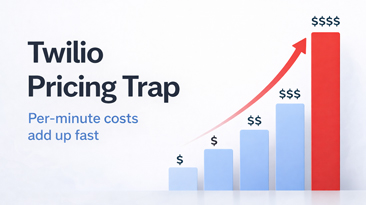
Per-minute pricing punishes success. Every new customer, every meeting, every minute adds to your bill. With WhiteLabelZoom, a busier platform costs slightly more in server resources, not dollars per participant minute. At 50,000 participant minutes per month, Whereby's annual cost can exceed $15,000--$25,000. WhiteLabelZoom's annual cost stays under $3,000 regardless of usage.
Branding Depth: Skinning a Widget vs Owning the Experience
Both platforms claim to offer white-label or branded video conferencing. The depth of that branding is fundamentally different.
Whereby: Surface-Level Customization
Whereby Embedded allows you to add your logo, adjust brand colors, hide certain UI elements, and use a custom subdomain. What you cannot do: redesign the meeting layout, modify the control bar, add custom UI components, or remove all traces of Whereby's design language. The meeting room is Whereby's product with your logo on it.
WhiteLabelZoom: Full Brand Ownership
WhiteLabelZoom allows you to replace every logo, color, font, and icon throughout the entire platform. You can customize the meeting UI layout, design custom landing pages and waiting rooms, and modify the admin dashboard. With source code access, you can redesign any component from scratch.
The difference is between putting a sticker on someone else's product and building your own. Your competitors can use the same Whereby widget with their logo. They cannot replicate a fully customized WhiteLabelZoom deployment.
Self-Hosting and Data Control
Whereby: Cloud-Only, Their Servers
All Whereby meeting data flows through their cloud infrastructure. You cannot deploy Whereby on your own servers or choose where data is processed. For healthcare (HIPAA), financial services (SOC 2), government, and education (FERPA), this is a deal-breaker.
WhiteLabelZoom: Your Servers, Your Rules
WhiteLabelZoom deploys on infrastructure you control --- AWS, DigitalOcean, a private data center, or an on-premises server behind a hospital's firewall. Meeting data never touches a third-party server. Recordings stay on your disks.
This is also a performance advantage. You can place servers where your users are concentrated, reducing latency. Whereby's server locations are fixed by their infrastructure decisions, not yours.
Who Should Use Whereby
Whereby is a reasonable choice if your situation matches these conditions:
- Video is a nice-to-have, not a core differentiator. If you just need a basic meeting widget and do not compete on the video experience, Whereby's simplicity is appealing.
- Your usage is very low and predictable. Under 5,000 participant minutes per month with no anticipated growth keeps Whereby's costs manageable.
- You need to ship in days, not weeks. Whereby's iframe embed can be integrated in a single afternoon.
- You have zero server management capability. If your team cannot manage any infrastructure, Whereby removes all operational burden.
- You do not need webinars, deep branding, or compliance certifications. Basic video rooms with your logo in an unregulated industry is Whereby's sweet spot.
Who Should Use WhiteLabelZoom
WhiteLabelZoom is the stronger choice if your situation matches these conditions:
-
Video is a core product feature. If your customers choose your product partly because of the video experience, you need to own and control it completely.
-
Your usage is growing. Once you cross roughly 8,000--10,000 participant minutes per month, WhiteLabelZoom's total cost drops below Whereby's and the gap widens every month after.
-
You need real white-labeling, not just a logo swap. Especially if you are reselling to clients, you need full customization control.
-
You operate in a regulated industry. Healthcare, finance, government, and education organizations that require data sovereignty or on-premises deployment need self-hosted infrastructure.
-
You want to build on top of the platform. Source code access means your team can add features and integrations impossible with a widget API.
-
You value long-term independence. No per-minute billing surprises, no forced API migrations, no vendor lock-in.
Frequently Asked Questions
1. Is WhiteLabelZoom a direct replacement for Whereby Embedded?
Yes. WhiteLabelZoom covers all core capabilities that Whereby Embedded provides --- video meetings, embeddable components, recording, screen sharing, chat, and API-driven room management --- plus additional features like webinars, whiteboard, and a full admin dashboard. The integration approach is different (self-hosted platform vs cloud widget), but the end-user experience is comparable or superior.
2. How long does it take to switch from Whereby to WhiteLabelZoom?
The typical migration timeline is one to two weeks: deploying WhiteLabelZoom on your server (a few hours), configuring branding (one to two days), and updating your application to use WhiteLabelZoom's SDK instead of Whereby's embed code. The integration patterns are similar, so code changes are straightforward.
3. Does WhiteLabelZoom support iframe embedding like Whereby?
Yes. WhiteLabelZoom can be embedded via iframe, JavaScript SDK, or direct API integration. If your current Whereby integration uses iframe embedding, the migration path is particularly simple --- you replace the Whereby room URL with your WhiteLabelZoom meeting URL and adjust configuration parameters.
4. How does per-minute pricing actually work at Whereby?
Every participant in a Whereby meeting is billed for every minute they are connected. A 45-minute meeting with 8 participants consumes 360 participant minutes. If your plan includes 10,000 minutes per month and you run 30 such meetings, you have used 10,800 minutes --- 800 of which are billed as overages. This adds up faster than most teams expect when estimating during initial integration.
5. Can WhiteLabelZoom match Whereby's ease of integration?
The initial integration takes slightly longer because you are deploying a server rather than adding an iframe. However, WhiteLabelZoom provides automated deployment scripts and Docker containers that bring initial setup to under a day. After deployment, the ongoing integration experience --- creating rooms via API, embedding meetings, managing participants --- is equally straightforward.
6. Does Whereby offer self-hosting or on-premises deployment?
No. Whereby is exclusively a cloud-hosted service. All media processing and data storage happens on their infrastructure. There is no self-hosted option, no on-premises deployment, and no way to control where meeting data is stored or processed beyond choosing their available regions.
7. How does video quality compare between the two?
Both platforms use WebRTC with adaptive bitrate streaming. Quality depends more on participant bandwidth and server proximity than the platform itself. Self-hosted WhiteLabelZoom lets you place servers closer to your users, which can improve latency and quality compared to Whereby's fixed data center locations.
8. Which platform is better for agencies building solutions for clients?
WhiteLabelZoom is significantly better for agencies. Each client deployment can have completely unique branding, its own domain, its own server, and its own data isolation --- with no per-minute costs eating into your margins. With Whereby, every client's usage adds to your aggregate per-minute bill, and the branding customization is limited to surface-level changes that may not satisfy clients who want a fully bespoke experience.
Final Verdict
Whereby and WhiteLabelZoom serve the same market from opposite philosophies.
Whereby is a video widget. You embed it, configure a few parameters, and pay per minute for every meeting. It is fast to integrate and requires zero infrastructure management. The trade-offs are rising costs as usage grows, shallow branding, no data sovereignty, and complete dependence on Whereby's pricing and roadmap.
WhiteLabelZoom is a video platform you own. You deploy it on your servers, brand it as your own, and pay nothing per minute regardless of usage. It requires a server and basic deployment knowledge, but in exchange you get full data control, unlimited customization, source code access, and permanent vendor independence.
For teams evaluating a whereby alternative for embedded video conferencing, the decision comes down to what video means for your business. If video is a checkbox feature you want to add quickly and cheaply, Whereby is a competent widget. If video is something your customers see, experience, and judge your product by, you need to own it --- not rent it by the minute.
WhiteLabelZoom lets you own it. Once. Forever. Without a meter running.